
Is Calculation Still Necessary in the Age of Generative AI?
Abstract
The rapid proliferation of Generative AI (GenAI) has precipitated a global debate regarding the necessity of human acquisition of basic academic skills. The SPRIX Education Foundation conducted the “International Survey on Basic Academic Skills and Learning Awareness 2025” to investigate how students and their parents / guardians (hereafter referred as guardians) perceive the value of fundamental calculation skills in an AI age. The study analyzed responses from eight countries, revealing that while the majority of respondents affirm the continued necessity of human calculation skills, a significant gap exists between guardians and children regarding this necessity. Furthermore, the findings highlight a critical link between a student’s lack of confidence and the devaluation of these skills.
1. Universal Recognition of Calculation in the AI Era
Across the majority of surveyed nations, over 70% of respondents believe basic calculation skills remain essential, even with the availability of GenAI.
2. The Guardian-Child Perception Gap
In 7 out of 8 countries surveyed, guardians are significantly more likely than their children to view calculation skills as necessary. This gap is particularly pronounced in Indonesia and Japan.
3. The “Confidence-Value” Link
There is a distinct correlation between self-confidence and the perceived value of calculation. Students who lack confidence in their abilities are more likely to dismiss calculation skills as unnecessary.
1. Introduction
The emergence of Generative AI, exemplified by tools like ChatGPT and Gemini, has streamlined complex calculations, prompting a fundamental redefinition of “what humans need to learn”. Consequently, the value of basic academic skills is being reassessed. Against this backdrop, the SPRIX Education Foundation sought to clarify how contemporary students and guardians perceive these foundational skills and how those perceptions are linked to their self-confidence.
This report focuses specifically on basic calculation skills, which are crucial for developing the “number sense” required to evaluate and verify the accuracy of AI-generated results. The study aims to determine if these “foundations” are being devalued in the public consciousness due to technological advancement.
2. Methodology
- Survey Period: April – July 2025.
- Participants: Primary focus on Grade 4 students and their parents (matched pairs) across 8 countries: USA, UK, France, South Africa, China, Indonesia, Nepal, and Japan.
- Method:
1. Internet Panel Survey: 5 countries (including USA, UK, France, South Africa, and China).
2. Classroom/Home Implementation: Indonesia, Nepal, Japan. - Assessment Design: Survey on Perceptions and Confidence, including questions regarding the necessity of calculation skills and students’ self-confidence. (See Appendix for detailed survey items.)
| Country | Method | Sample Size(Children) | Sample Size(Guardians) |
|---|---|---|---|
| USA | Panel | 150 | 150 |
| UK | Panel | 150 | 150 |
| France | Panel | 150 | 150 |
| South | Africa Panel | 150 | 150 |
| China | Panel | 150 | 150 |
| Indonesia | Classroom/Home | 48 (1 School) | 23 |
| Nepal | Classroom/Home | 81 (3 Schools) | 67 |
| Japan | Classroom/Home | 373 (6 Schools) | 235 |
Notes on Data Collection & Attribution
- In the surveys conducted in schools and homes (Indonesia, Nepal, and Japan), respondents were not selected via random sampling. While results are presented by country name for convenience, please note that they reflect findings from specific regions and participating schools.
- When citing this report, please attribute it to the “SPRIX Education Foundation.”
- The survey was administered by SPRIX Inc. and Cross Marketing Inc. on behalf of the SPRIX Education Foundation, and the analysis was conducted by the Foundation using anonymized data. Specific respondent counts have been withheld to ensure anonymity.
3. Results
3.1. Universal Recognition of Calculation in the AI Era
The study first addressed the fundamental question: Generative AI can solve various problems, such as translating foreign languages. Do you think “Basic calculation” skills are still necessary for you, even with generative AI available?
Figure 1(a) compares the percentage of guardians and children who affirmed the necessity of calculation skills across the eight surveyed nations. Here, the data presented exclusively represents matched pairs of guardians and children from the same household.
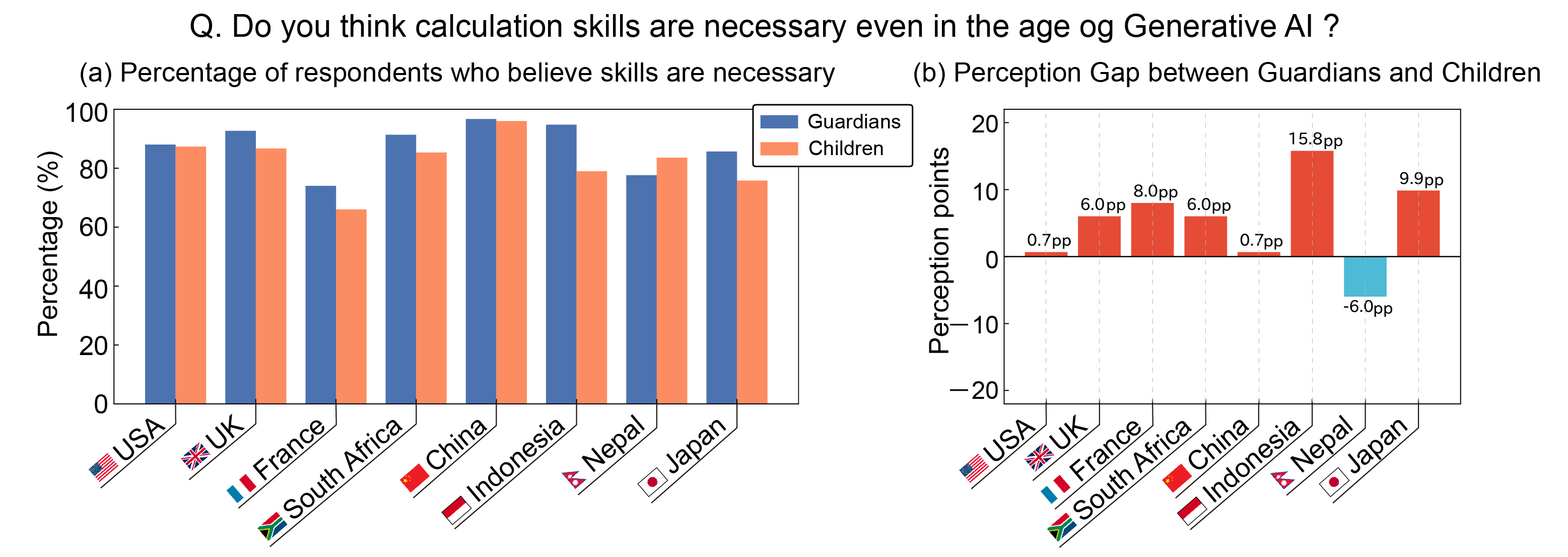
(a) Comparison of affirmative response rates from guardians and children across eight surveyed nations.
(b) The perception gap between guardians and children (Guardian % ― Child %), highlighting the significant disparity particularly in Indonesia and Japan.
This figure demonstrates a global consensus: in the USA, UK, South Africa, and China, over 80% of both guardians and children believe that human calculation skills remain essential. While France, Nepal, and Japan showed slightly lower percentages, the majority still affirmed the importance of these skills. This indicates that the necessity for basic numeracy is widely recognized, contradicting the assumption that society would readily abandon these skills for automation.
3.2. The Perception Gap Between Guardians and Children
While the overall recognition of necessity is high, a closer look reveals a disparity between generations.
Figure 1(b) illustrates the “awareness gap” by subtracting the children’s affirmative response rate from that of the guardians. In 7 out of the 8 countries, guardians rated the necessity of calculation higher than their children. This suggests that guardians, drawing from their own life and professional experiences, may recognize the practical value of foundational skills more clearly than the digital-native generation. However, Nepal stands as a notable exception where students showed higher appreciation for these skills than their guardians, suggesting that regional educational contexts may uniquely influence these perceptions.
3.3. The “Confidence-Value” Link
We further investigated why some students view calculation as “unnecessary,” focusing on the psychological factor of self-confidence.
Figure 2(a) shows the results for seven countries (excluding Japan), revealing a clear trend: the perceived necessity of calculation decreases significantly as students’ confidence levels drop. While confident students overwhelmingly affirm the value of this skill, this recognition diminishes noticeably among those with lower self-confidence. This correlation between low confidence and the devaluation of skills is consistent across the global average.
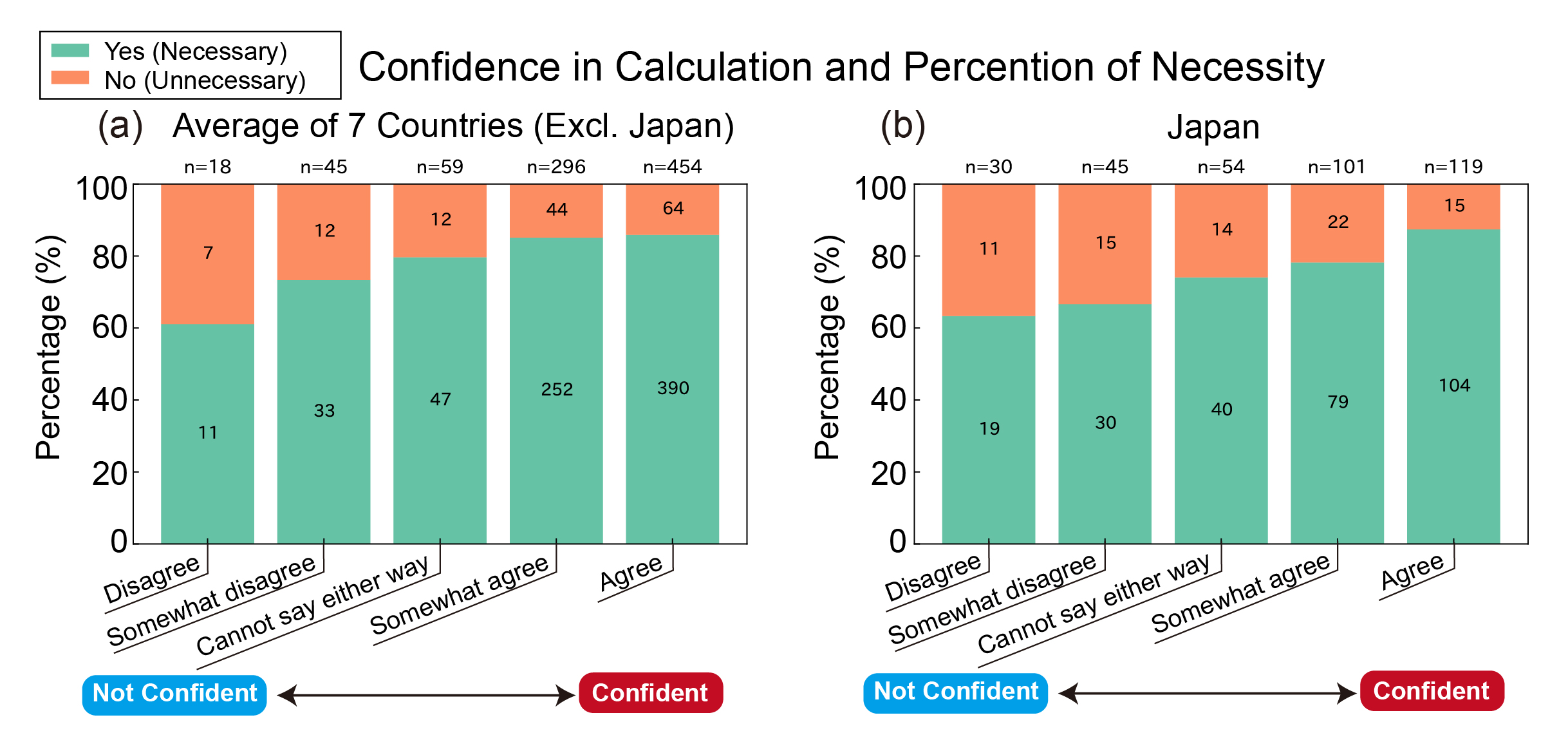
(a) Average response trends for seven surveyed countries (excluding Japan), illustrating the decline in perceived value as students’ confidence decreases. Here, The Y-axis represents the percentage of total respondents, while the numbers displayed within the bars (e.g., 390, 104) indicate the raw count of respondents in each category.
(b) Specific response trends in Japan, showing a clear correlation where perceived necessity declines steadily in step with decreasing student confidence.
Using the detailed data from Japan as a case study, we observe a remarkably clear and steady version of this trend [Fig. 2(b)]. This reinforces the theory that students struggling with calculation are more likely to view AI as a replacement for human effort, potentially using its existence to rationalize a lack of engagement with foundational learning.
4. Discussion
he findings of this international survey offer critical insights for educators. While the majority agree that basic calculation remains vital, the significant gap between guardians and children suggests that students—especially those with lower confidence—are at risk of underestimating the value of these skills.
The findings suggest a potential negative pattern: Low Confidence → Devaluation of Skill (Rationalization via AI). This is a concerning trend, as it may lead students to lose their motivation to study and acquire the foundational skills necessary for their development. So, how can we foster this essential confidence in students? We will explore hints and strategies for this in our next report.
Appendix: Key Survey Items
1. For Guardians: “Generative AI can solve various problems, such as translating languages. Do you think “Basic calculation skills” are still necessary for your child, even with generative AI available? (Options: Yes / No)
2. For Children (Question 1): Generative AI can solve various problems, such as translating foreign languages. Do you think “Basic calculation skills” are still necessary for you, even with generative AI available? (Options: Yes / No)
3. For Children (Question 2): Do you agree with the following statements about studying? Please select one answer for each statement. → “I’m confident in my calculation skills” (Options: Agree / Somewhat agree / Cannot say either way / Somewhat disagree / Disagree)
Contact Information
SPRIX Education Foundation Survey Desk
Address: Shibuya Sakura Stage SHIBUYA Tower 22F, 1-1 Sakuragaoka-cho, Shibuya-ku, Tokyo 150-6222
URL: https://sprix-foundation.org/en
Information about TOFAS
TOFAS (Test of Fundamental Academic Skills) is a global assessment platform for fundamental academic skills, developed and provided by SPRIX Inc. For more information, please visit the official website: https://tofas.education/
Information about Subcontracted Research Companies
SPRIX, Inc. (https://sprix.inc/en/)
Established in Japan in 1997, SPRIX Inc. has the mission of improving students’ future prospects by instilling confidence and enhancing their learning capabilities. The company provides a wide range of educational services, including industry-leading personalized tutoring schools, textbooks and teaching materials, academic skill assessments, online education platforms, and academic research.
Cross Marketing Inc. (https://www.cross-m.co.jp/en/)
As a core subsidiary of the TSE Prime-listed Cross Marketing Group, Cross Marketing Inc. (established in 2003) has over two decades of experience specializing in global market research. With more than 20 offices in over 10 countries, they offer an extensive global perspective and comprehensive data-driven solutions.