
Knowledge or Application? How Parents in 10 Countries Define "Fundamental Academic Skills"
Abstract
In Japan, “fundamental (or basic) academic skills” (kiso gakuryoku) is a familiar term in education, but what it refers to is rarely clearly defined, either in Japan or internationally. We, the SPRIX Education Foundation, a Tokyo-based foundation, conducted the “International Survey of Fundamental Academic Skills 2026” to investigate how parents of primary and lower secondary school students in ten countries (Japan, the Philippines, Indonesia, Vietnam, Thailand, Kyrgyzstan, Kenya, Egypt, Morocco and Peru) understand the term. We found that while parents in nearly all countries consider these skills important, their views on what the skills include differ, with Japanese parents in particular emphasizing knowledge and skills over the ability to apply them.
1. The term is recognized in all ten countries, and most parents see it as important
In every country, more than half of parents said they hear or see the term at least “sometimes.” In nine countries (all except Morocco), more than 80% said fundamental academic skills are important for their child’s future.
2. Japanese parents mainly associate the term with “knowledge and skills”
Japanese parents most often chose reading and writing skills (76.0%), calculation skills (68.0%) and basic knowledge of main academic subjects (64.2%), that is, core subjects such as mathematics and languages. Japan was the only country in which the top three answers were all “knowledge and skills.”
3. In the other nine countries, the ability to apply knowledge ranks highest
In each of the other nine countries, the ability chosen most often was one of applying knowledge, such as understanding and using information or finding and solving problems, although which ability ranked first varied by country.
1. Introduction
You would probably agree that children need solid “basic skills.” But what exactly counts as basic? Japan offers one example of how the answer can change over time. In Japanese education, the term kiso gakuryoku, which we translate here as “fundamental academic skills,” has been widely used for decades. When Japan revised its national curriculum guidelines (the Courses of Study) in 1958, “strengthening fundamental academic skills” was stated as a clear goal, and the main measure was more emphasis on Japanese language and arithmetic [1]. Later government documents came to describe academic ability as including not only knowledge and skills but also the ability to apply them, such as thinking skills, and the motivation to learn [1, 2]. The current Courses of Study, issued by Japan’s Ministry of Education, organize these into three pillars: “knowledge and skills,” “abilities to think, make judgments and express oneself,” and “motivation to learn and humanity” [1]. A leading Japanese education scholar has even argued that no one can give the term a single definition [3] (see also “Supplementary Note: Changing Views of Academic Ability” at the end of this report).
If the meaning of “basic” can shift this much within one country, it may differ even more across countries, and from person to person. People who agree that fundamental academic skills are important may still have quite different abilities in mind, whether in conversations between schools and families or in international discussions.
In this survey, we therefore asked parents of primary and lower secondary school students in ten countries whether fundamental academic skills are important and which abilities the term includes. The aim was to show how each country understands the “basics” of academic ability.
2. Methodology
- Survey Period: April – August 2026.
- Countries: Japan, Philippines, Indonesia, Vietnam, Thailand, Kyrgyzstan, Kenya, Egypt, Morocco and Peru.
- Participants: Parents/guardians of children in the equivalent of Grades 4, 5, 8 and 9 (hereafter “primary and lower secondary school students”). In some countries, parents of Grade 6 (Thailand) or Grade 7 (Indonesia, Morocco) students were also included.
- Sample Size: 3,547 parents/guardians (as of September 1, 2026). These are interim results, and figures may change in the final tally.
- Method: Conducted by SPRIX Inc. on behalf of the SPRIX Education Foundation, at one to several schools per grade and at home. Participation by parents was voluntary.
- Assessment Design: Survey on awareness of fundamental academic skills, their importance and the abilities they include. (See Appendix for detailed survey items.)
| Country | Sample Size (Parents/Guardians) |
|---|---|
| Japan | 438 |
| Philippines | 266 |
| Indonesia | 220 |
| Vietnam | 663 |
| Thailand | 353 |
| Kyrgyzstan | 156 |
| Kenya | 142 |
| Egypt | 211 |
| Morocco | 344 |
| Peru | 754 |
| Total | 3,547 |
Notes on Data Collection & Attribution
- The survey covered schools that volunteered to take part from among those that took TOFAS (Test of Fundamental Academic Skills), provided by SPRIX Inc., during the survey period. Respondents were not randomly selected. While results are presented by country name for convenience, please note that they reflect findings from specific regions and participating schools, not from each country as a whole.
- “Overall” figures are the simple total of all respondents in the ten countries and are not weighted to account for differences in sample size between countries.
- Percentages are rounded to one decimal place, so totals may not add up to 100%, and differences calculated from the rounded figures may differ slightly from those reported, which are calculated from unrounded values.
- The questionnaires were translated into the language used in each country. The survey items in the Appendix are shown in their English version.
- When citing this report, please attribute it to the “SPRIX Education Foundation.”
- The survey was administered by SPRIX Inc. on behalf of the SPRIX Education Foundation, and the analysis was conducted by the Foundation using anonymized data.
3. Results
3.1. The Term Is Recognized in All Ten Countries, and Most Parents See It as Important
Is the term “fundamental academic skills” known in every country? We asked parents in the ten countries: “How often do you hear or see the term ‘basic/fundamental academic skills’ in your country?” (Figure 1).
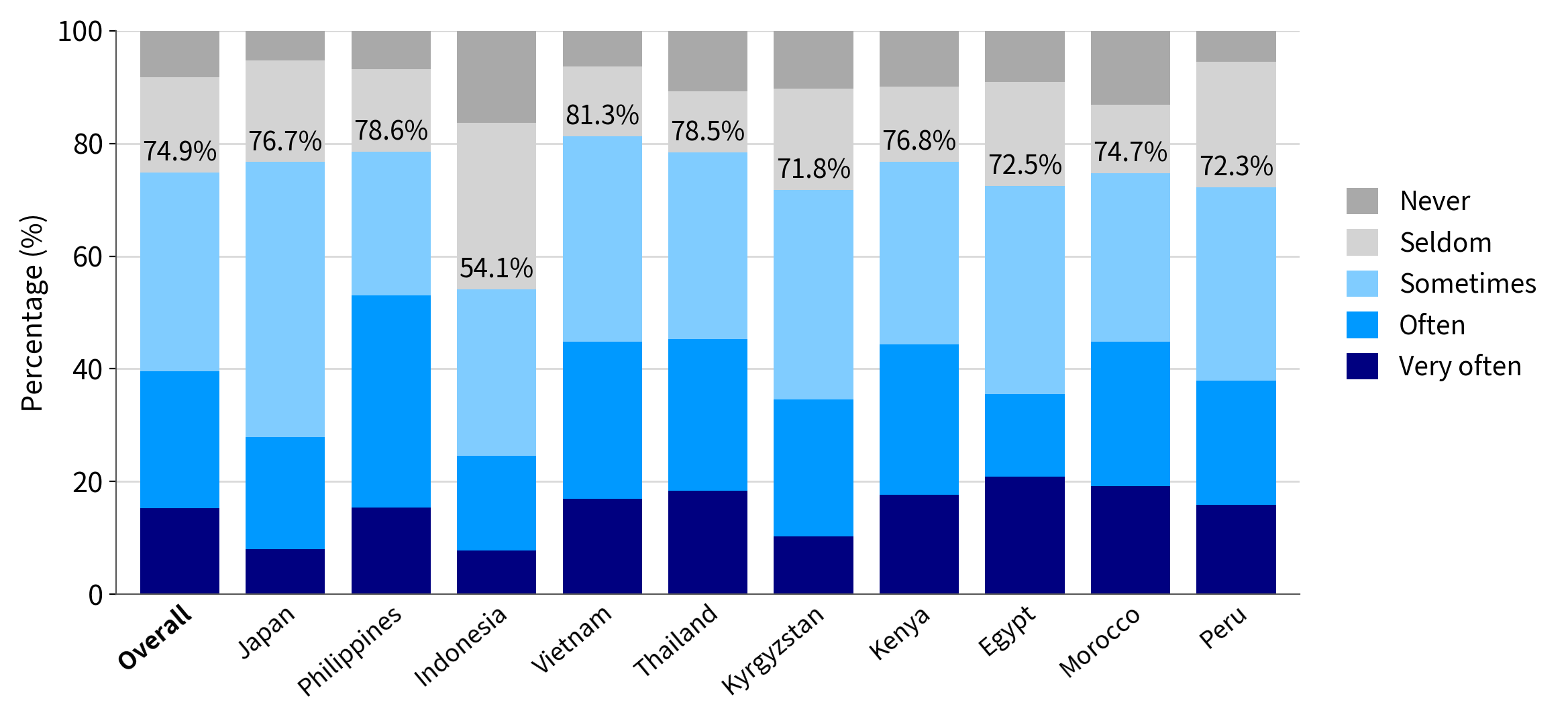
Across the ten countries, 74.9% of parents said they hear or see the term at least “sometimes” (the total of “very often,” “often” and “sometimes”). By country, the figure was above 70% in nine countries, the exception being Indonesia (54.1%).
How important, then, do parents think fundamental academic skills are? We asked the same parents: “How important do you believe basic/fundamental academic skills are for your child’s future?” (Figure 2).
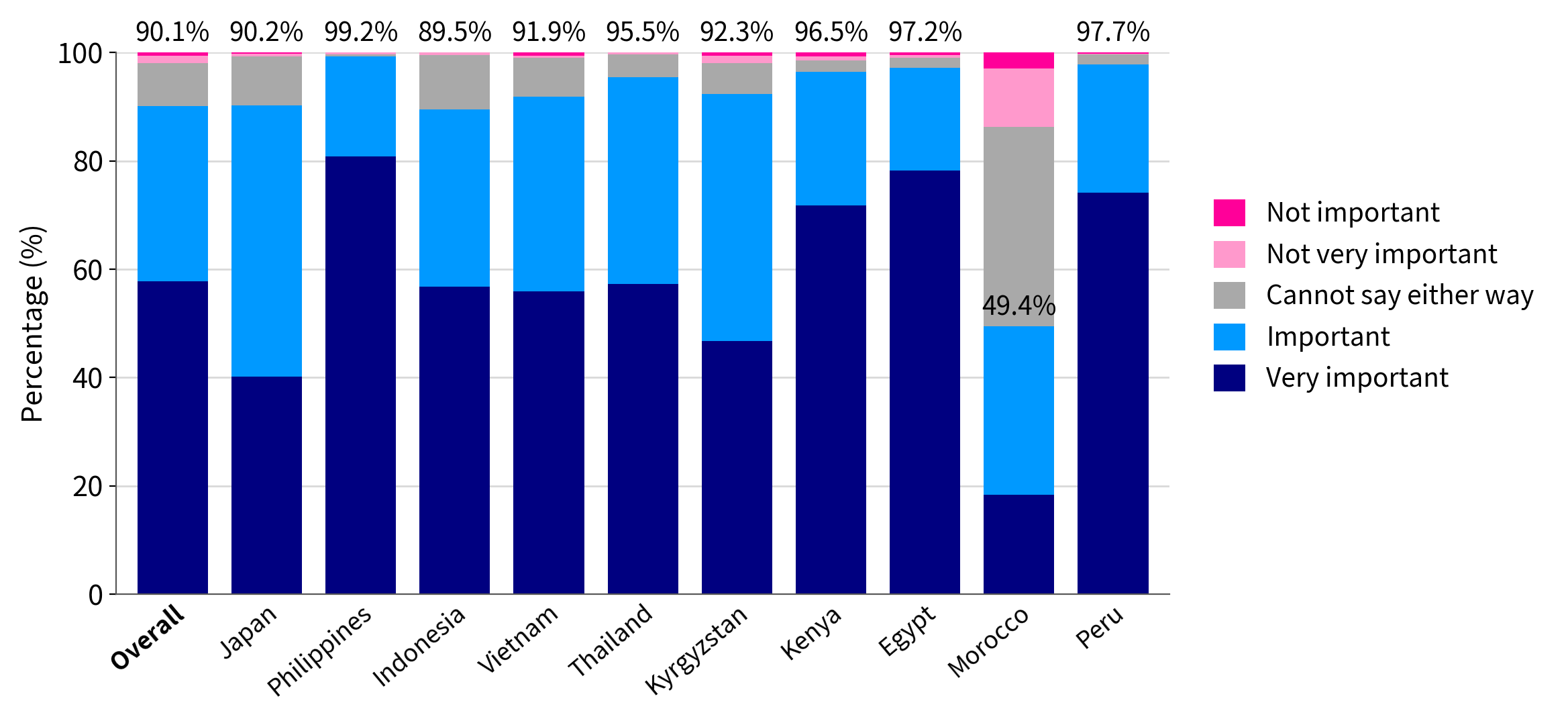
Across the ten countries, 90.1% of parents said fundamental academic skills are important (the total of “very important” and “important”). In nine countries, all except Morocco, more than 80% of parents answered this way. In Morocco, 49.4% said the skills are important and 36.9% chose “cannot say either way.” In the ten countries surveyed, the term is fairly common, and in most of them parents regard fundamental academic skills as important.
3.2. Japanese Parents Mainly Associate the Term with “Knowledge and Skills”
What, then, are these “important fundamental academic skills”? We first look at the answers from Japan, where our Foundation is based. We asked parents: “What abilities do you think are mainly included in ‘basic/fundamental academic skills’?” Parents could select all that apply (Figure 3).
In this report, we group the answer options into three categories, following the three pillars of Japan’s Courses of Study described in the Introduction [1]:
- Knowledge & Skills (corresponding to the first pillar): reading and writing skills; calculation skills; basic knowledge of main academic subjects
- Applying Knowledge (corresponding to the second pillar): ability to correctly understand and use information; ability to clearly express your own ideas; ability to find and solve problems; ability to think logically
- Motivation to Learn (corresponding to the third pillar): attitude and motivation toward learning
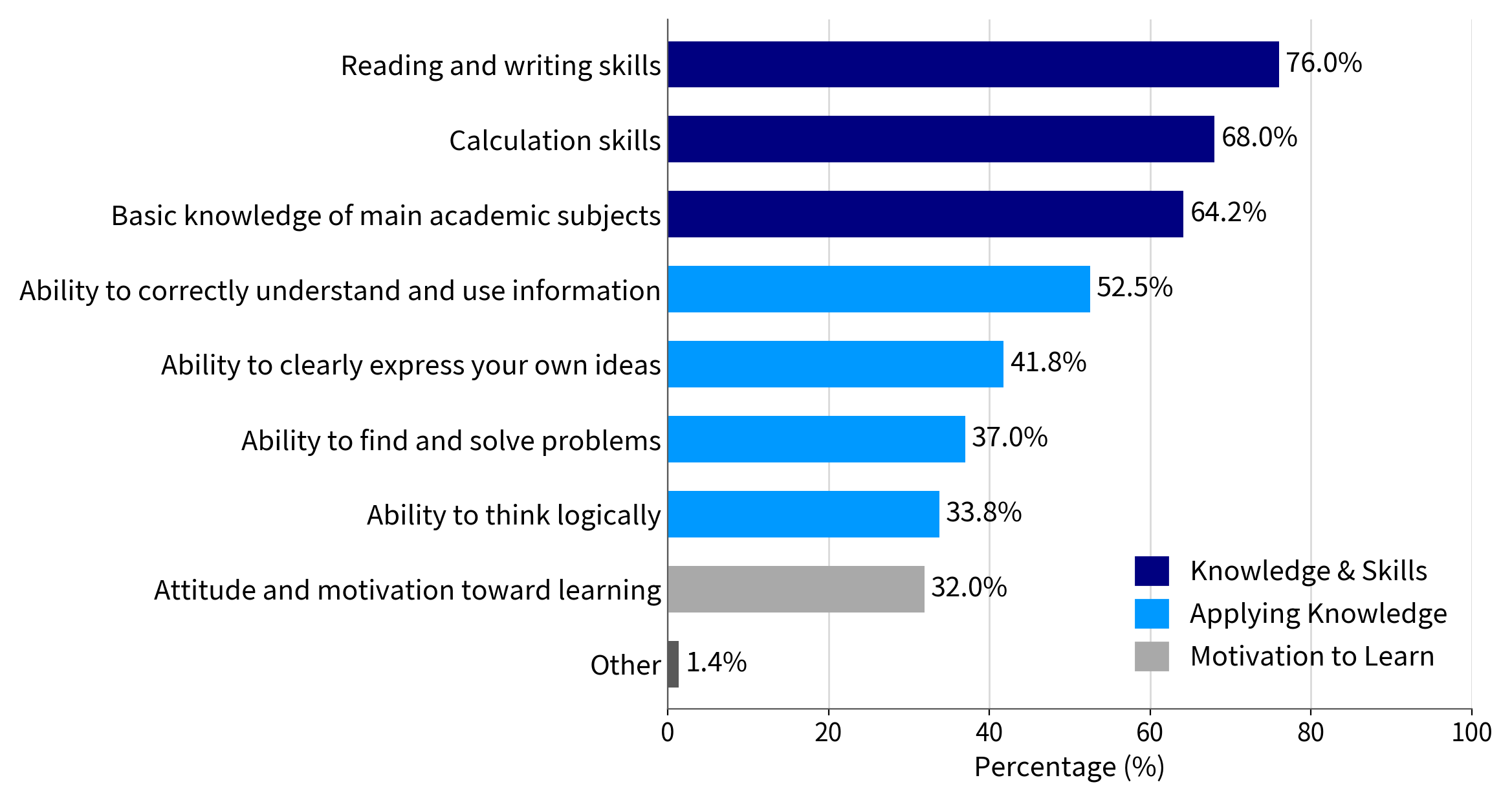
In Japan, the most common answer was reading and writing skills (76.0%), followed by calculation skills (68.0%) and basic knowledge of main academic subjects (64.2%), that is, core subjects such as mathematics and languages. All three fall under “knowledge and skills” [1], while the other options fall under applying knowledge or motivation to learn. Japanese parents tend to see fundamental academic skills as knowledge and skills rather than as the ability to apply them or the motivation to learn.
3.3. Parents in the Other Nine Countries Mainly Point to the Ability to Apply Knowledge
How do parents in the other countries understand the term? We asked parents in all ten countries the same question (Table 1).
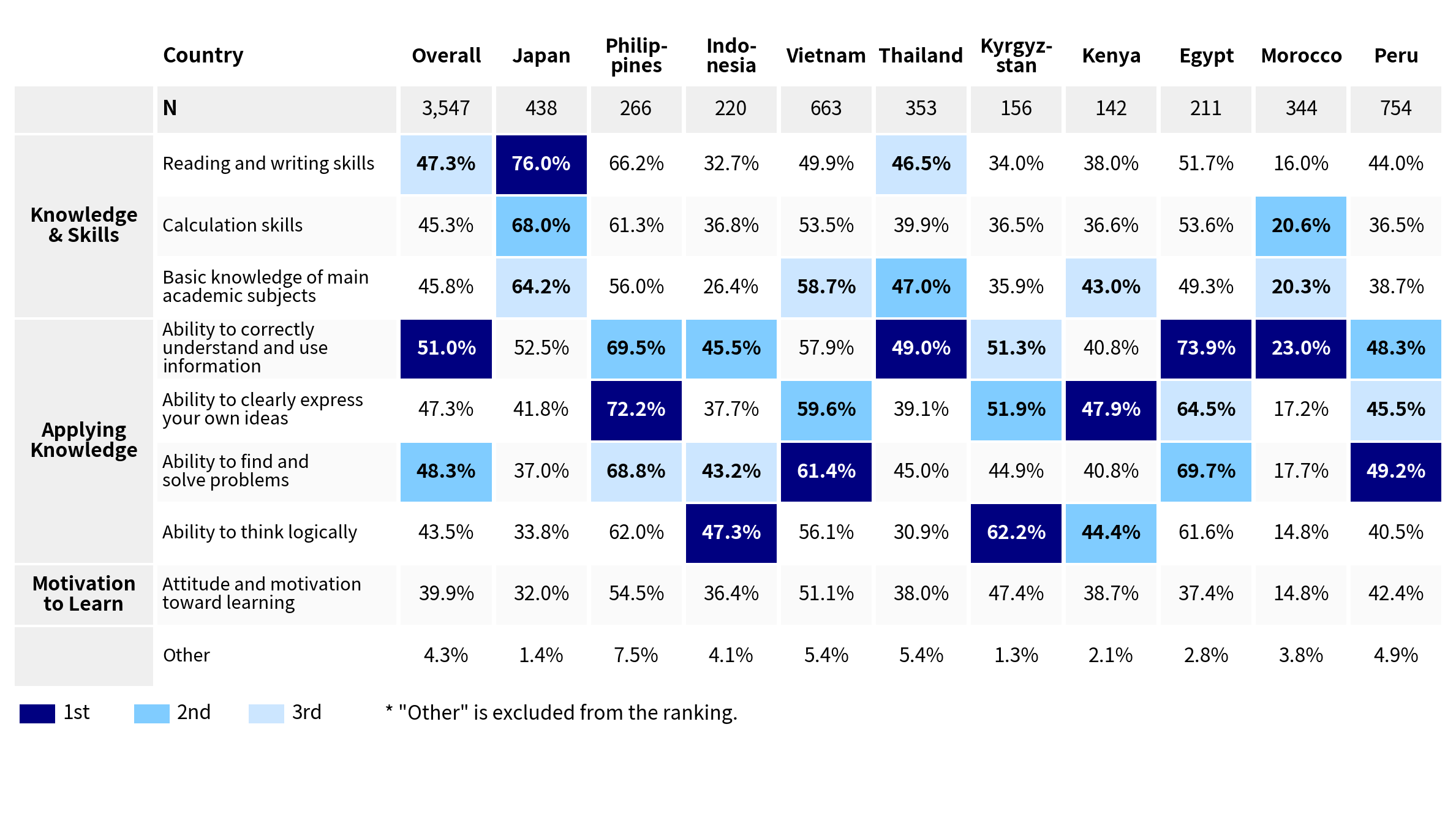
Across all ten countries, the most common answer was the ability to correctly understand and use information (51.0%), followed by the ability to find and solve problems (48.3%). Excluding “Other,” however, the answers ranged only from 39.9% to 51.0%. Responses were spread across the options rather than concentrated on one.
By country, some abilities show clear differences. Japan’s answers were the most distinctive. Japanese parents most often chose reading and writing skills, calculation skills and basic knowledge of main academic subjects, and for each of these three, Japan had the highest rate of the ten countries. Japan was also the only one of the ten countries in which the top three answers were all “knowledge and skills.” For the “applying knowledge” options, by contrast, Japan ranked 4th of the ten countries for understanding and using information, 7th for expressing one’s own ideas, 8th for thinking logically and 9th for finding and solving problems.
Japan also had the largest gap between options. Excluding “Other,” the difference between the most chosen option in Japan, reading and writing skills (76.0%), and the least chosen, attitude and motivation toward learning (32.0%), was 44.1 percentage points. The next largest gaps were in Egypt (36.5 points) and Kyrgyzstan (28.2 points); in the other seven countries, the gap was between 8 and 21 points. Compared with the other countries, Japanese parents identify fundamental academic skills with knowledge and skills to a particularly strong degree.
In every country other than Japan, the option chosen most often was an “applying knowledge” ability: the ability to think logically (Indonesia, Kyrgyzstan), the ability to find and solve problems (Vietnam, Peru), the ability to correctly understand and use information (Thailand, Egypt, Morocco) and the ability to clearly express one’s own ideas (Philippines, Kenya). The second and third choices also leaned toward applying knowledge rather than knowledge and skills. This does not mean these countries see fundamental academic skills only as applying knowledge: in Thailand and Morocco, for example, the second and third choices were knowledge and skills. In no country, including Japan, did attitude and motivation toward learning rank in the top three.
Among the nine countries other than Japan, the top three were all “applying knowledge” in five countries (Philippines, Indonesia, Kyrgyzstan, Egypt, Peru), while the other four (Vietnam, Thailand, Kenya, Morocco) had a mix of knowledge and skills and applying knowledge. Which abilities parents include in fundamental academic skills varies from country to country.
4. Discussion
The term “fundamental academic skills” is recognized in all ten countries, and parents in nine countries (all except Morocco) share the view that these skills are important. What the term includes, however, differs by country. Japanese parents most often chose reading and writing skills, calculation skills and basic knowledge of main academic subjects. Japan was the only one of the ten countries in which the top three answers were all knowledge and skills. In the other nine countries, parents tended to rank abilities to apply knowledge, such as understanding and using information and finding and solving problems, higher.
These results show that agreeing that fundamental academic skills are important is not the same as agreeing on what they are. In international discussions, and when schools communicate with families, the term alone may not carry the same meaning for everyone. It helps to state what it refers to each time it is used.
Differences in meaning can also arise within a single country. As described in the Introduction, Japanese education policy has broadened its idea of what is “basic,” from an emphasis on Japanese language and arithmetic in 1958 to the three pillars of today’s Courses of Study, which include the ability to apply knowledge and the motivation to learn. Yet Japanese parents’ answers were closer to the earlier view, which Japanese educational research describes as the “traditional” one [3]. The basics defined in policy and the basics that parents have in mind may not yet be the same (see also the Supplementary Note).
Appendix: Key Survey Items (Parents)
Question 1: “In Japanese education, there is a concept called ‘basic/fundamental academic skills.’ How often do you hear or see the term ‘basic/fundamental academic skills’ in your country?” (Options: Very often / Often / Sometimes / Seldom / Never)
Terms used for “basic/fundamental academic skills” in each country’s questionnaire:
| Country | Language | Term |
|---|---|---|
| Japan | Japanese | 基礎学力 (kiso gakuryoku) |
| Philippines | Filipino | pangunahing/saligang kasanayang pang-akademiko |
| Indonesia | Indonesian | keterampilan akademik dasar/fundamental |
| Vietnam | Vietnamese | kỹ năng học tập cơ bản/nền tảng |
| Thailand | Thai | ทักษะวิชาการพื้นฐาน |
| Kyrgyzstan | Kyrgyz | негизги академиялык көндүмдөр |
| Kenya | English | basic/fundamental academic skills |
| Egypt | Arabic | المهارات الأكاديمية الأساسية |
| Morocco | Arabic | المهارات الدراسية الأساسية |
| Peru | Spanish | habilidades académicas básicas/fundamentales |
Question 2: “How important do you believe basic/fundamental academic skills are for your child’s future?” (Options: Very important / Important / Cannot say either way / Not very important / Not important)
Question 3: “What abilities do you think are mainly included in ‘basic/fundamental academic skills’? Please select all that apply. Even if you answered ‘Never’ in the previous question, please imagine and answer based on the sound of the words or their meanings.” (Options: Reading and writing skills / Calculation skills / Basic knowledge of main academic subjects / Ability to think logically / Ability to find and solve problems / Ability to correctly understand and use information / Ability to clearly express your own ideas / Attitude and motivation toward learning / Other)
Supplementary Note: Changing Views of Academic Ability
1. Neither “academic ability” nor “fundamental academic skills” has a single definition
The Japanese word for academic ability, gakuryoku, was coined as a translation of the English word “achievement.” However, because it contains the character ryoku (ability or power), it has been pointed out that the word took on a meaning and image different from the original English, giving rise to a wide variety of views on what academic ability is [3]. In 2009, Manabu Sato, then a professor at the University of Tokyo, stated that it is impossible for anyone to give a single definition of gakuryoku or kiso gakuryoku [3]. This ambiguity is not limited to the Japanese language. Internationally, too, there has never been a single agreed answer to what counts as academic ability.
2. What has been measured as academic ability outside Japan
Attempts to compare academic ability across countries have a long history. The founding meeting of the International Association for the Evaluation of Educational Achievement (IEA) was held in 1958, and in 1964 the First International Mathematics Study was conducted with 12 participating countries [4]. This line of work later developed into TIMSS (Trends in International Mathematics and Science Study), which has been conducted every four years since 1995 [4, 5].
Around the same time, the idea of what it means to be “able” also broadened. The 1965 UNESCO World Congress of Ministers of Education on the Eradication of Illiteracy (Tehran) held that literacy should be regarded not as the skills of reading and writing in themselves but as a means of preparing people for social, civic and economic roles, and the definition of “functional literacy” adopted in 1978 requires that people be able to continue to use reading, writing and calculation for their own development and that of their community [6]. In other words, the standard shifted from whether people can read and write to whether they can use these skills in society.
This difference also appears in assessments of academic ability. TIMSS, mentioned above, measures how well students have acquired the knowledge and skills learned in the school curriculum. PISA (Programme for International Student Assessment), which began in 2000, assesses 15-year-olds at the end of compulsory education and measures how well they can apply their knowledge and skills to challenges they face in a variety of real-life situations [5]. Even among assessments of “academic ability,” what is measured differs depending on whether they look at what students have learned or at what they can use.
Furthermore, the OECD launched the DeSeCo (Definition and Selection of Competencies) project in 1997 and, in 2003, set out three key competencies: “using tools interactively,” “interacting in heterogeneous groups” and “acting autonomously” [7]. These describe what people should be able to do beyond the boundaries of school subjects. Among the countries in this survey, Peru (2016), Kenya (2017), Vietnam (2018) and Kyrgyzstan (2022) have introduced competency-based curricula [8].
3. What has been measured as academic ability in Japan
Japan’s current national assessment of academic ability is the National Assessment of Academic Ability, which began in 2007. It was initially divided into questions mainly testing “knowledge” and questions mainly testing “application,” and from the 2019 school year it was revised to assess both together [9]. However, this was not Japan’s first national assessment. The Ministry of Education also conducted national academic achievement tests from 1956 to 1966, and for four years from 1961 these covered all lower secondary schools in the country [10]. The launch in 2007 was the first assessment covering all students in a given grade in 43 years [9]. In other words, efforts to measure academic ability on a national scale began in Japan at almost the same time as international comparative assessments were getting under way.
4. Where “fundamental academic skills” stands
The 1950s and 1960s, when the national academic achievement tests were conducted, were also the period when the term kiso gakuryoku appeared explicitly in government documents. The 1958 revision of the Courses of Study clearly set out “strengthening fundamental academic skills” as a goal, and the main measure was more emphasis on Japanese language and arithmetic [1]. Later, the 2000 report of the Curriculum Council stated that the basics include not only knowledge and skills but also the motivation to learn on one’s own and the abilities to think, make judgments and express oneself [2]. The 2008 revision incorporated the kind of “ability to apply knowledge” that PISA measures [11], and the 2017 revision set out the following three pillars, giving more concrete form to the idea of a “zest for life” [1]:
- Knowledge and skills (what students understand and what they can do)
- Abilities to think, make judgments and express oneself (how students use what they understand and can do)
- Motivation to learn and humanity (how students engage with society and the world and lead a better life)
The term kiso gakuryoku does not appear in the main text of the current commentary on the Courses of Study, which instead uses the expression “basic and fundamental knowledge and skills.”
5. Comparing with the results of this survey
Among the countries in this survey, Kenya’s curriculum sets out seven core competencies, with “Communication and Collaboration” listed first. Vietnam’s curriculum lists “problem-solving and creativity” as one of its general competencies [8]. In this survey, the ability chosen most often by parents in Kenya was the ability to clearly express one’s own ideas, and in Vietnam it was the ability to find and solve problems.
Japan also set out the three pillars of competencies in its 2017 revision, and the direction of its education system is not very different from that of the other countries. In this survey, however, Japanese parents most often chose reading and writing skills, calculation skills and basic knowledge of main academic subjects. This is close to the emphasis on Japanese language and arithmetic set out in 1958 under the goal of “strengthening fundamental academic skills,” suggesting that the view of reading, writing and arithmetic as the core of fundamental academic skills remains strong today.
References (English titles of Japanese sources translated by the Foundation)
[1] Ministry of Education, Culture, Sports, Science and Technology (MEXT). Commentary on the Courses of Study for Elementary Schools (2017 Notification): General Provisions (『小学校学習指導要領(平成29年告示)解説 総則編』). July 2017. (For the 1958 revision, see the appendix “History of Revisions to the Courses of Study” in the same volume.)
[2] Curriculum Council. Report on the Evaluation of Student Learning and the Implementation of the Curriculum (「児童生徒の学習と教育課程の実施状況の評価の在り方について(答申)」). December 4, 2000.
[3] Center for Advanced School Education and Evidence-based Research, The University of Tokyo (ed.). Questioning Fundamental Academic Skills: Prospects for Japanese Education in the 21st Century (『基礎学力を問う ― 21世紀日本の教育への展望』). University of Tokyo Press, 2009. (Chapter 1: Manabu Sato, “The Structure of the Academic Achievement Problem and the Concept of Fundamental Academic Skills” (「学力問題の構図と基礎学力の概念」).)
[4] International Association for the Evaluation of Educational Achievement (IEA). “History” and “Early IEA Studies”; IEA 1958–2008.
[5] MEXT. “International Assessments of Academic Ability (PISA, TIMSS)” (「国際学力調査(PISA、TIMSS)」) and “Overview of the PISA and TIMSS Surveys” (「PISA調査とTIMSS調査の概要」).
[6] UNESCO. EFA Global Monitoring Report 2006: Literacy for Life, Chapter 6.
[7] OECD. The Definition and Selection of Key Competencies: Executive Summary, 2005.
[8] National curriculum documents: Kenya, Basic Education Curriculum Framework, 2017; Vietnam, Chương trình giáo dục phổ thông (General Education Program), 2018; Peru, Currículo Nacional de la Educación Básica, 2016; Kyrgyzstan, State Educational Standard for General School Education, 2022.
[9] MEXT. “Overview of the National Assessment of Academic Ability” (「全国学力・学習状況調査の概要」); FY2006 White Paper on Education, Culture, Sports, Science and Technology.
[10] National Institute for Educational Policy Research (NIER). “Past Test Materials (National Academic Achievement Tests, 1956–1966)” (「過去のテスト資料(全国学力調査 1956~1966年度)」).
[11] Central Council for Education. Report on the Improvement of the Courses of Study for Kindergartens, Elementary Schools, Lower and Upper Secondary Schools and Special Needs Schools (「幼稚園、小学校、中学校、高等学校及び特別支援学校の学習指導要領等の改善について(答申)」). January 17, 2008.
Contact Information
SPRIX Education Foundation Survey Desk
Address: Shibuya Sakura Stage SHIBUYA Tower 22F, 1-1 Sakuragaoka-cho, Shibuya-ku, Tokyo 150-6222
URL: https://sprix-foundation.org/en
E-mail: survey@sprix-foundation.org
Information about TOFAS
TOFAS (Test of Fundamental Academic Skills) is a global assessment platform for fundamental academic skills, developed and provided by SPRIX Inc. For more information, please visit the official website: https://tofas.education/
Information about Subcontracted Research Company
SPRIX, Inc. (https://sprix.inc/en/)
Established in Japan in 1997, SPRIX Inc. has the mission of improving students’ future prospects by instilling confidence and enhancing their learning capabilities. The company provides a wide range of educational services, including industry-leading personalized tutoring schools, textbooks and teaching materials, academic skill assessments, online education platforms, and academic research.